

Staring at a forty-tab browser at 11:30 PM with a half-marked chemistry past paper open on your desk should trigger panic, yet you feel nothing at all. Zero drive. When student emotional health collapses under relentless exam pressure, your brain does not always explode into tears; instead, it quietly pulls the emergency brake and locks you into protective flatness. Having mentored thousands of high-performing students through brutal GCSE, A-Level, AP, and university final seasons, I have watched top achievers mistake this neurological shutdown for laziness.
You are not lazy. Your autonomic nervous system is simply out of fuel.
Standard school counselors hand out colorful revision timetables or tell you to take a bubble bath. Wrong. Baths do not fix a fried prefrontal cortex when three chapters of organic chemistry or history essays are due by Monday morning. Real recovery requires Non-Clinical, evidence-based protocols that recalibrate your stress response while keeping your academic momentum intact.
What Is Student Emotional Health in High-Stakes Academic Environments?
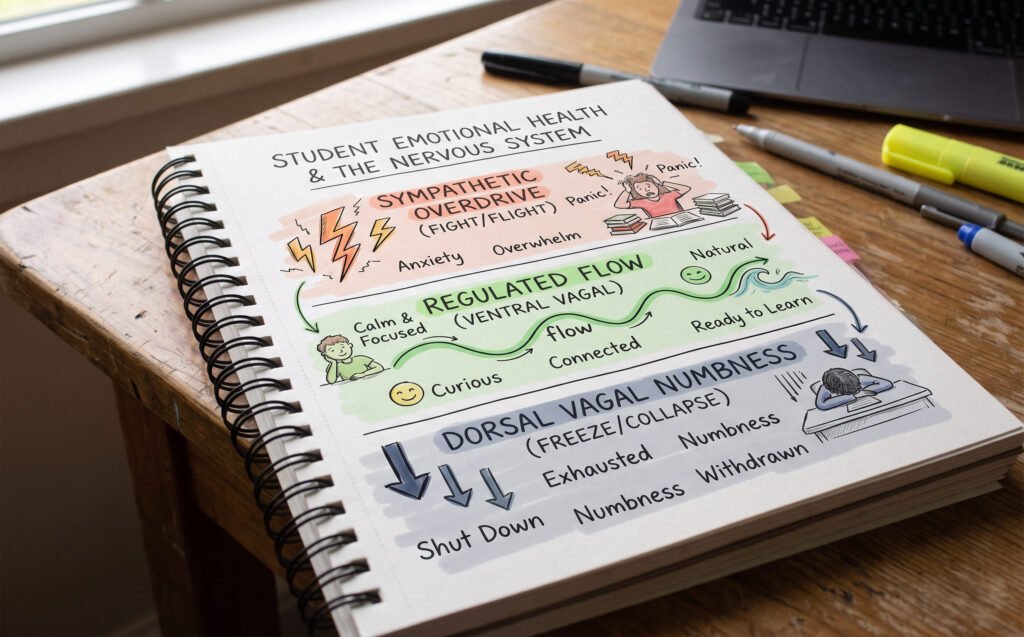
Student emotional health is the neurological capacity to regulate exam stress, tolerate heavy cognitive loads, and shift smoothly between focused sympathetic alertness and restorative parasympathetic rest. Rather than constant happiness, it measures how effectively your brain processes syllabus pressure and grading feedback without collapsing into chronic cortisol resistance or dorsal vagal numbness.
Neuro-Emotional State | Primary Neuro-Mechanism | Internal Student Monologue | Typical Study Behavior | Immediate Recovery Protocol |
| 1. Regulated Flow (Ventral Vagal + Balanced Dopamine) | Optimal prefrontal cortex blood flow; baseline norepinephrine supports working memory. | “This module is dense, but I can break down two sub-topics before dinner.” | Active recall via Feynman Technique or Interleaved Practice; clean 50-minute focus blocks. | 10-minute outdoor walk; hydration; zero-screen micro-breaks. |
| 2. Sympathetic Overdrive (Hyper-Anxious Grind) | Elevated HPA-axis cortisol and adrenaline; amygdala hijacks executive planning. | “If I stop revising for twenty minutes, I will fail my finals and ruin my future.” | Compulsive highlighting; rereading notes five times; frantic midnight cramming with low retention. | Physiological Sighs; switching to closed-book Leitner Flashcards to constrain scope. |
| 3. Dorsal Vagal Shutdown (Protective Numbness) | Cortisol receptor downregulation; depleted mesolimbic dopamine baseline; freeze response. | “My exam is in four days. I have six chapters left. I honestly do not care anymore.” | Staring at a blank Google Doc for two hours; doomscrolling in bed with a textbook open on your chest. | 5-Minute Friction Rule; Blurting Method on a single sub-topic; somatic cold-water reset. |
Most productivity advice assumes you operate inside State 1. How absurd. By mid-April or November exam blocks, nearly every ambitious student oscillates violently between State 2 and State 3.
Recognizing which state dominates your desk tonight changes everything. Pushing harder when you are trapped in Sympathetic Overdrive only accelerates cognitive fatigue, whereas forcing a four-hour marathon during Dorsal Vagal Shutdown guarantees another evening of staring at the wall in silence.
Why Does Student Emotional Health Collapse During Exam Season?
Student emotional health collapses during exam season because months of uninterrupted syllabus pressure trigger chronic hypothalamic-pituitary-adrenal (HPA) axis activation, flooding the brain with cortisol until receptors downregulate. Combined with a depleted dopamine baseline from delayed academic gratification, the nervous system shifts from anxious hyper-arousal into protective emotional blunting.
Academic burnout rarely arrives overnight. According to neuroendocrine research indexed by the National Center for Biotechnology Information (NIH), prolonged academic stress disrupts sleep homeostasis, impairs executive working memory, and shifts the autonomic nervous system toward sympathetic dominance while reducing vagal tone. Look closer at the three biological traps driving this collapse.
1. The Dopamine Deficit of Delayed Academic Gratification
Human brains evolved for immediate feedback loops. You hunt, you eat, and your mesolimbic pathway releases dopamine. High-stakes education destroys that loop by demanding nine months of daily cognitive exertion for a single piece of paper issued in August.
Every time you force yourself through two hours of calculus or literature analysis without an immediate reward, your tonic dopamine baseline drops a fraction lower. Week after week, the effort-to-reward ratio skews deeper into the red. Soon, activities that used to recharge you—gaming, gym sessions, or catching up with friends—feel completely gray.
2. Academic Validation Addiction and Threat-Based Studying
Fear works brilliantly as short-term rocket fuel. Using the terror of a bad grade to force yourself out of bed at 6:00 AM triggers a sharp spike of adrenaline and norepinephrine that narrows visual focus. And yet, it backfires.
Relying on threat-based motivation wires your amygdala to treat every practice quiz like a physical predator. When your entire identity hangs on an A* or a 4.0 GPA, a single dropped mark triggers a full biological threat response. Breaking free from academic validation addiction is the only way to study at an elite level without letting a difficult mock paper shatter your nervous system for seventy-two hours.
3. Protective Limbic Blunting (When Panic Turns to Apathy)
Have you ever panicked about an exam for six straight weeks, only to wake up forty-eight hours before the test feeling weirdly calm and completely indifferent? That is not peace. It is a fuse blowing.
Neurobiologists refer to this as HPA-axis attenuation or protective limbic blunting. Because sustained high-cortisol states damage hippocampal neurons, your brain eventually throttles its own stress receptors to protect itself. If you are currently experiencing emotional numbness from studying, your nervous system has entered a dorsal vagal freeze state because the perceived syllabus backlog exceeded your cognitive load capacity.
How to Audit Your Student Emotional Health (The 60-Second Autonomic Check)
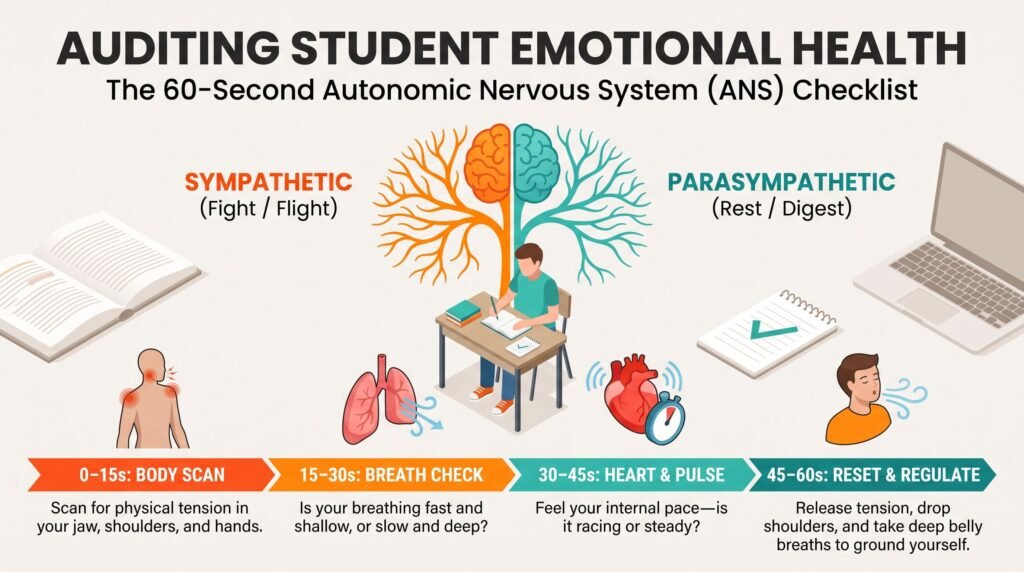
To audit your student emotional health in 60 seconds, measure four behavioral markers before opening your textbook: task initiation latency, emotional reactivity to minor formatting errors, rest-induced cortisol spikes, and sensory flatness after completing a module. Scoring two or more markers indicates autonomic dysregulation rather than a discipline deficit.
Stop guessing whether you are genuinely exhausted or just procrastinating. Run through this four-point diagnostic right now:
- Task Initiation Friction Over 20 Minutes: You sit down with clear materials, yet your eyes slide off the page onto your phone for twenty-five minutes because starting feels physically heavy in your chest.
- Micro-Frustration Spikes: Dropping a pen, losing a PDF tab, or getting a single multiple-choice question wrong makes your throat tighten with sudden anger or tears.
- The Phantom Syllabus Effect: Sitting on the sofa for thirty minutes triggers a rising pulse and an obsessive mental scroll through every chapter you have not memorized yet.
- Completion Hollowness: Finishing a brutal three-hour past paper brings zero relief—only an immediate voice whispering that you should have finished it faster.
💡 Mentor Pro-Tip: Why 90% of Revision Timetables Fail
Color-coded spreadsheets assume your emotional bandwidth is identical at 9:00 AM on a Tuesday and 8:00 PM on a Friday. When you schedule heavy essay synthesis during a low-dopamine window, you fail the block, feel guilty, and abandon the entire timetable by Wednesday. Schedule by neurological energy state, not by clock hours.
4 Evidence-Based Protocols to Rebuild Student Emotional Health Without Losing Grades
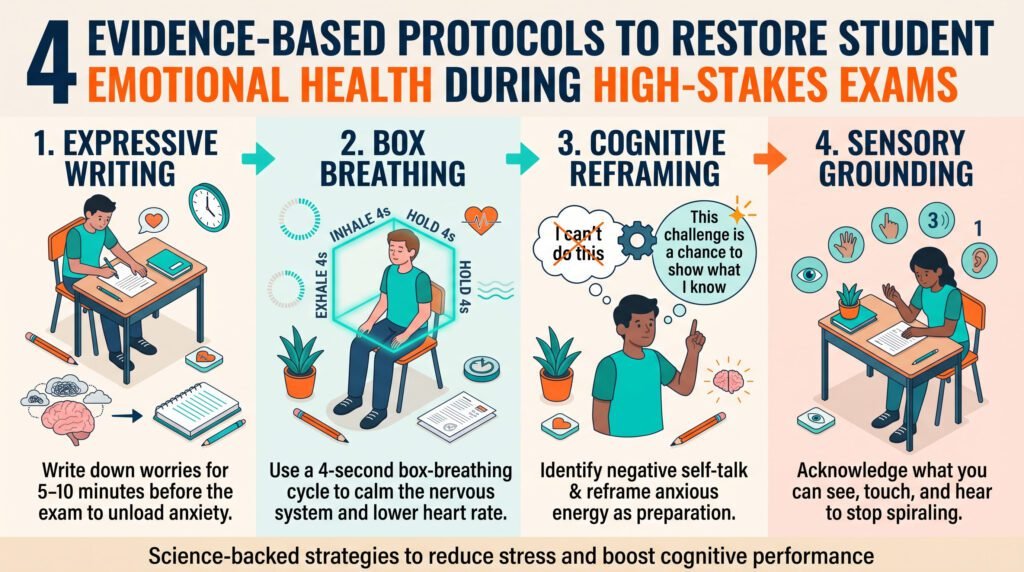
Rebuilding student emotional health during exam season requires four targeted behavioral protocols: executing a Zeigarnik open-loop shutdown ritual at night, switching to 5-minute blurting triage on low-energy days, using physiological sighs between 90-minute ultradian blocks, and pacing dopamine decompression immediately after final papers conclude.
You cannot simply take a month off when finals start in three weeks. Recovery must happen inside the trenches of your revision schedule.
Protocol 1: The Zeigarnik “Open-Loop” Shutdown to Eliminate Study Guilt
Soviet psychologist Bluma Zeigarnik discovered that the human brain remembers uncompleted tasks twice as vividly as completed ones. When you slam your laptop shut at 10:00 PM mid-chapter, your prefrontal cortex keeps running background threads on those unfinished topics all night. No wonder your sleep feels shallow.
End every evening study session with a strict 3-Minute Open-Loop Shutdown. Grab a physical index card never your phone and write down the exact three micro-steps you will execute first tomorrow morning (e.g., “1. Open Biology Paper 2; 2. Mark Questions 4–7; 3. Make 5 flashcards on mitosis errors”). Closing the cognitive loop convinces your working memory that the threat is contained, which is the fastest mechanical fix for eliminating study guilt during rest.
Protocol 2: Low-Friction Active Recall for Poor Student Emotional Health Days
When your student emotional health hits rock bottom, passive reading is a trap. Staring at a textbook requires sustained endogenous attention that an exhausted prefrontal cortex cannot supply, causing you to read the same paragraph six times and hate yourself for failing.
Lower the activation energy immediately. Combine the 5-Minute Friction Rule with the Blurting Method:
- Pick one tiny sub-topic (half a page maximum).
- Skim the core headings for ninety seconds, then close the book.
- Set a timer for three minutes and scribble every formula, date, or mechanism you remember onto scrap paper as messily as possible.
- Check your gaps in red ink and stop if your brain still feels locked.
Externalizing memory onto paper forces active recall without demanding hours of willpower. On severe fatigue days, restrict yourself strictly to Box 1 and Box 2 of your Leitner Flashcard System for fifteen minutes, then walk away.
Protocol 3: Physiological Sighs and Somatic Down-Regulation Between Study Blocks
Grinding for four hours straight destroys retention because the brain operates on Ultradian 90/20 Cycles—ninety minutes of high-frequency neural firing followed by a mandatory twenty-minute trough to clear metabolic waste. Ignoring that trough floods your bloodstream with backup cortisol.
Between focus blocks, do not scroll TikTok or Instagram. Rapid short-form video hijacks visual processing networks and drains the exact dopamine pool you need for your next study block. Instead, perform three Physiological Sighs (two sharp inhales through the nose to maximally inflate alveolar sacs, followed by one long, slow exhale through the mouth). As research on emotional regulation and academic stress confirms, actively regulating autonomic arousal directly preserves academic motivation and prevents emotional exhaustion.
Protocol 4: Buffering the Post-Exam Dopamine Drop
Nobody warns you about the hour after your final exam ends. You walk out of the exam hall expecting euphoria, yet by that evening you feel hollow, irritable, or physically feverish.
Sudden removal of a massive stressor triggers the biological “Let-Down Effect,” where adrenaline and cortisol plummet faster than your immune and dopamine systems can recalibrate. To protect yourself from a brutal post-exam emotional crash, plan a 72-Hour Taper Window after your last paper: avoid binge-sleeping fourteen hours in the dark, schedule low-stimulation outdoor movement, and introduce structured sensory rewards rather than rotting in bed scrolling for two days straight.
Daily Emotional Hygiene Schedule for High-Performing Students (Sample Template)
How do you fit nervous system regulation into a packed ten-hour revision day? Stop treating recovery as a separate two-hour hobby and weave it into your transition windows using this template:
| Time Window | Academic / Revision Action | Neuro-Emotional Hygiene Mechanism | Why It Works Biologically |
| First 30 Mins Awake | Zero syllabus check; zero phone screen; natural outdoor light + water. | Tonic Dopamine Protection | Prevents premature cortisol spikes and preserves baseline dopamine for morning recall. |
| Block 1 (90 Mins) | High-cognitive load task (Feynman Technique or past-paper essay synthesis). | Single-Tab Constraint | Aligns peak morning prefrontal alertness with high-friction material. |
| Transition (20 Mins) | Step away from desk; 3 Physiological Sighs + protein snack + stare at distant horizon. | Ultradian Vagal Reset | Offloads visual focal tension and switches the autonomic nervous system back to parasympathetic mode. |
| Afternoon Triage | Low-friction active recall (5-Minute Blurting or Leitner System review). | Cognitive Load Downshifting | Bypasses the afternoon circadian dip by using short, externalized retrieval prompts. |
| Hard Cutoff (9:30 PM) | Write tomorrow’s 3 micro-steps on an index card; close all tabs and books. | Zeigarnik Open-Loop Closure | Signals task safety to the amygdala so deep slow-wave sleep can consolidate memory. |
Final Verdict: Protecting Your Student Emotional Health for the Long Haul
No university admissions officer, employer, or grading examiner will ever ask how many nights you cried over your desk to earn your transcript. Grades measure your short-term ability to retrieve syllabus patterns under timed conditions—never your worth as a human being.
When you treat student emotional health as the biological foundation of memory consolidation rather than a luxury you can postpone until July, both your scores and your sanity recover. Grab a blank index card tonight, write down just three micro-tasks for tomorrow morning, close your laptop thirty minutes early, and let your nervous system finally stand down.
FAQ
What are the physical signs of poor student emotional health during exam season?
Poor student emotional health manifests as chronic task initiation friction, micro-frustration spikes over minor errors, the phantom syllabus effect causing resting heart rate increases, and post-study hollowness where finishing a major paper brings zero relief or satisfaction.
Why do I feel completely numb and apathetic right before my final exams?
Emotional numbness before exams is caused by protective limbic blunting and dorsal vagal shutdown. When prolonged stress and high cortisol overwhelm your prefrontal cortex, your nervous system triggers an autonomic freeze response to prevent further cognitive damage.
How can I stop feeling guilty when I take a break from studying?
Eliminate rest-induced guilt by executing a structured 3-minute evening shutdown ritual. Writing down your next morning’s micro-steps on an index card closes open mental loops, satisfying the Zeigarnik effect and allowing true parasympathetic recovery.