

Staring at a glowing Google Doc at 11:14 PM with fourteen browser tabs open, a half-empty mug of cold coffee, and an Anki deck overdue by 412 cards is not a discipline failure. Your brain is simply out of metabolic fuel. Most high school, sixth-form, and university students treat study productivity as an endurance sport measured by hours logged in a desk chair.
Wrong. Real study productivity measures how many retrievable neural pathways you build per hour of cognitive effort, not how many pastel highlighters you bleed dry before midnight. Whether you are facing GCSEs, A-Levels, AP exams, the SAT, South Korea’s CSAT, or university finals, grinding for ten hours a day triggers sympathetic nervous system overdrive and ruins memory consolidation.
⚡ Key Takeaways for Exhausted Students:
- Output Over Hours: High study productivity depends on active synaptic encoding (blurting, interleaved problem sets, and error logging) rather than passive re-reading.
- Friction Beats Willpower: Lowering task initiation friction with a 5-minute entry protocol bypasses executive dysfunction when your dopamine baseline crashes.
- Biological Pacing: Structuring revision around 90/20 ultradian cycles prevents afternoon brain fog and keeps working memory intact during exam season.
Why Does Traditional Study Productivity Fail During High-Stakes Exam Seasons?
Traditional study productivity fails during high-stakes exam seasons because passive marathon sessions overload working memory and trigger chronic cortisol spikes. Under Cognitive Load Theory, cramming unorganized information exceeds prefrontal cortex bandwidth, creating an illusion of competence where students recognize textbook pages visually but cannot retrieve answers under timed exam conditions.
Sit in any university library in mid-May and watch what happens around hour six. Students copy textbook paragraphs onto iPad screens in neat calligraphy while their actual retention drops to near zero.
Why? Because human working memory can only hold and process roughly four chunks of novel information at a single time, a bottleneck documented extensively in cognitive load research published via PubMed. Pushing past that biological ceiling forces your brain into threat-response mode. Cortisol floods the hippocampus. Encoding stops cold.
What Is the “Illusion of Competence” in Passive Revision?
The illusion of competence in passive revision occurs when students mistake visual familiarity with study material for genuine long-term memory mastery. Re-reading highlighted notes, watching lecture recordings at double speed, or copying mark schemes activates low-effort visual recognition rather than the effortful prefrontal retrieval required to pass closed-book exams.
Familiarity is a trap. When you read a biology summary sheet for the fourth time, your visual cortex processes the text fluently and whispers, “I know this.”
Here’s the catch. Recognizing a definition when it sits right in front of your eyes uses a completely different neural circuit than generating that definition from a blank exam paper. You can test your own revision immediately using the Recognition vs. Retrieval Audit:
- Close every tab and notebook: Put away your textbook, iPad, and summary sheets for sixty seconds.
- Write three core mechanisms from memory: Pick the exact topic you spent the last hour reading and explain how it works on scratch paper.
- Score the retrieval gap: Anything you could not write down without peeking never entered long-term storage, regardless of how neat your notes look.
How Cortisol Spikes and Syllabus Backlog Guilt Drain Working Memory
Falling behind on a revision timetable creates a secondary cognitive tax called syllabus backlog guilt. Every uncompleted task sits open in your mind like a background browser tab eating up RAM.
Instead of focusing on the single chemistry stoichiometry question in front of you, half of your prefrontal cortex is busy calculating how many chapters remain before Monday’s mock exam. That internal panic elevates baseline norepinephrine and fragments attention. High-performing students protect their study productivity by separating planning mode from execution mode—once a study block begins, the rest of the syllabus does not exist for the next forty-five minutes.
| Metric / Habit | Fake Study Productivity (Aesthetic Grind) | Neuro-Academic Study Productivity (High-Yield) |
| Primary Metric | Hours spent sitting at a desk (8–12 hours/day) | Weak-topic questions solved from memory (3–5 hours/day) |
| Core Mechanism | Passive re-reading, highlighting, rewriting notes | Closed-book blurting, past papers, interleaved drills |
| Cognitive Load | High extraneous load (formatting, color-coding) | High germane load (building synaptic retrieval pathways) |
| Nervous System State | Chronic cortisol spike + evening revenge bedtime procrastination | Regulated ultradian focus peaks + guilt-free rest |
| Exam Hall Outcome | Blank-outs on unfamiliar multi-step questions | Fast pattern recognition under timed pressure |
How Do You Fix Task Initiation Friction When Your Brain Refuses to Start?
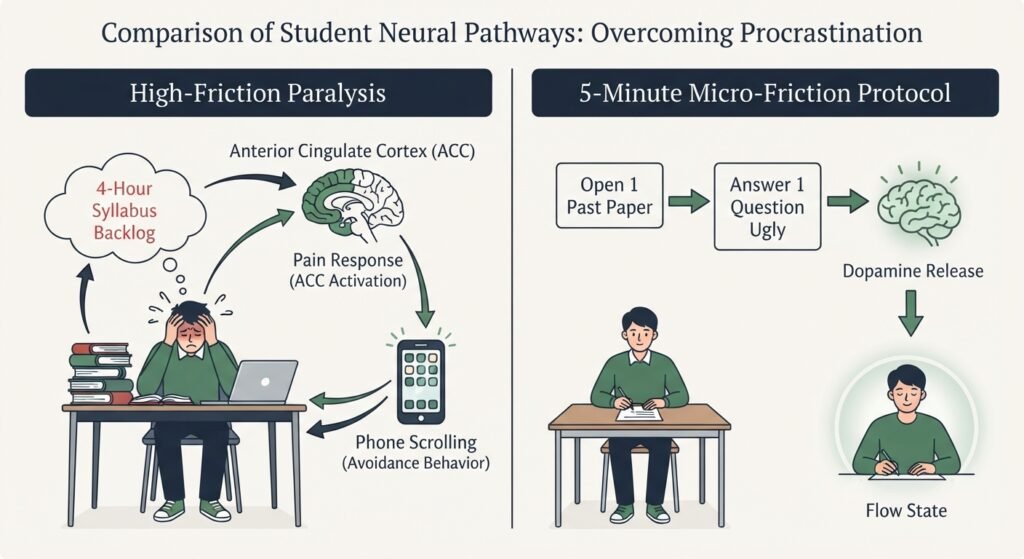
To fix task initiation friction when your brain refuses to start, shrink the entry threshold of your study task until it requires less than two minutes of effort. Starting with a single past-paper question or a messy three-bullet outline bypasses anterior cingulate cortex threat detection and restores baseline dopamine momentum.
Staring at a blank screen for two hours is exhausting. You are not lazy; you are experiencing task initiation paralysis.
Neuroimaging studies show that anticipating a massive, ambiguous academic task—like “Revise all of Macroeconomics”—activates the insular cortex, the exact brain region associated with physical pain. Naturally, your brain seeks immediate relief by reaching for short-form video feeds. Breaking that loop requires mechanical friction reduction, which we cover step-by-step in our guide on how to start studying when unmotivated.
The 5-Minute Micro-Friction Rule for Blank-Page Paralysis
Stop trying to hype yourself up to study for three hours. Willpower is a terrible ignition switch when your dopamine baseline is flatlined.
Use the Ugly First Draft / 1-Question Entry Protocol instead:
- Strip the setup ritual: Leave your desk slightly pre-loaded the night before with the exact PDF page open and a scratchpad already on top of your keyboard.
- Commit to one ugly rep: Tell yourself you only have to answer one multiple-choice question, write three terrible bullet points for an essay, or review ten flashcards before you have permission to stop.
- Leverage the Zeigarnik Effect: Once a task is physically opened, your brain experiences mild cognitive tension until the pattern is completed, pulling you naturally into a 30-minute session without forcing it.
🧠 Mentor Pro-Tip: Never write a subject name like “Biology” or “Calculus” on your to-do list. Vague nouns paralyze tired brains. Write a physical verb and a micro-unit instead: “Blurt 8 bullet points on Mitosis on blank paper.”
Which Study Productivity Methods Actually Double Retention in Half the Time?
The study productivity methods that double retention in half the time are closed-book active recall, spaced repetition, and interleaved problem practice. According to cognitive psychology benchmarks, forcing your brain to retrieve information without prompts strengthens synaptic myelination up to 150% more effectively than passive textbook review over identical timeframes.
Working harder on the wrong cognitive mechanism is like sprinting on ice. You burn massive energy and go nowhere.
Landmark memory research by Roediger and Karpicke in Psychological Science proved that students who tested themselves once recalled significantly more information a week later than students who repeatedly studied the exact same passage four times in a row. Every time you struggle for ten seconds to pull a formula out of your head, you signal to your hippocampus that the memory is essential for survival.
Why the Blurting Method Beats Aesthetic Note-Taking for Study Productivity
The Blurting Method boosts study productivity by turning passive reading into an immediate diagnostic retrieval test. By writing down everything you remember about a subtopic on blank paper and filling gaps in red ink, you isolate exact knowledge blind spots within fifteen minutes and eliminate wasted revision hours.
Throw out the ruler and the five-color brush pens. Aesthetic summaries feel soothing because they carry zero risk of failure, whereas true study productivity thrives on exposing what you do not know yet.
Run this 15-Minute Closed-Book Blurt & Red-Pen Gap Audit whenever you finish a topic:
- Read or skim for 5 minutes: Scan the syllabus specification points or a concise summary sheet with a strict timer running.
- Close the book and blurt for 7 minutes: Grab a blank sheet of A4 paper and scribble every formula, date, diagram, and causal link you can recall—messy handwriting encouraged.
- Audit in red ink for 3 minutes: Open your source material, add everything you missed or misstated in red pen, and turn only those red ink gaps into Leitner flashcards.
For a complete breakdown of how to pair blurting with the Feynman Technique and spaced intervals, read our tactical protocol on the active recall study method.

How Interleaved Practice Prevents Exam-Hall Blank-Outs
Have you ever aced twenty textbook practice problems at the end of Chapter 4, only to freeze completely when the exact same concept showed up on a cumulative mock paper? That happens because textbook chapters use blocked practice (A-A-A-A-B-B-B-B).
Blocked practice lets your brain run on autopilot. You already know which formula to use because you are on the “Integration by Parts” worksheet. Real exams never tell you which chapter a question comes from. Switching to an A-B-C-A-B-C problem mix forces your brain to select the strategy before executing the calculation—a high-yield technique detailed in our guide to interleaved practice for exams.
How Should You Structure a Daily Study Productivity Schedule Without Burning Out?
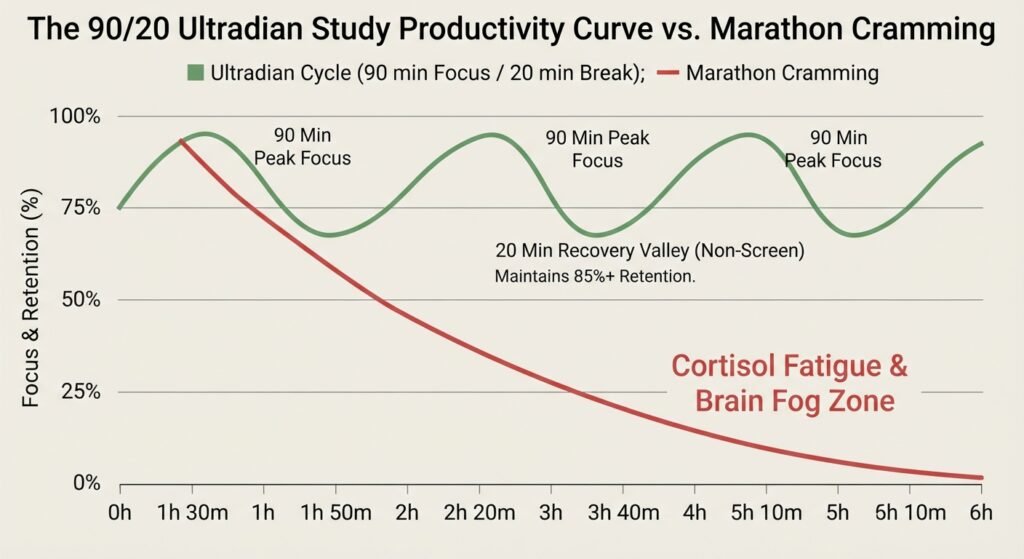
To structure a daily study productivity schedule without burning out, align your hardest analytical tasks with biological 90-minute ultradian focus cycles followed by 20-minute non-screen recovery breaks. Capping deep cognitive work at three 90-minute blocks per day preserves prefrontal neurotransmitters and prevents the late-afternoon exhaustion caused by marathon cramming.
Most revision timetables die by Wednesday. Why? Because students schedule themselves like robots blocking out 8:00 AM to 10:00 PM in neat one-hour color blocks with zero margin for human biology.
Your brain operates on a biological pulse known as the Basic Rest-Activity Cycle (BRAC). Both during sleep and waking hours, human alertness rises to a peak and dips into a trough roughly every 90 to 110 minutes. Ignoring that dip by chugging an energy drink and pushing through hours four and five destroys your afternoon study productivity.
Ultradian 90/20 Cycles vs. Pomodoro Fatigue
Twenty-five-minute Pomodoro timers work well when you cannot bring yourself to start an annoying administrative task. However, once you are deep inside an A-Level physics calculation, an AP History document-based essay, or a complex coding problem, a ringing alarm at minute 25 shatters your cognitive flow state.
Transitioning to a ultradian rhythm study schedule gives your brain 15 minutes to warm up, 60 minutes of deep analytical execution, and 15 minutes to consolidate before a mandatory 20-minute biological reset.
⚠️ The Golden Rule of the 20-Minute Reset: Scrolling TikTok, Instagram Reels, or Reddit during your break is not rest. High-velocity visual feeds flood your visual cortex with novelty and overwrite the delicate hippocampal memory traces you just spent 90 minutes building. Walk to the kitchen, stare out a window, stretch, or close your eyes.
The 3-Tier Energy Triage Timetable (High, Medium, and Zombie-Mode Blocks)
Match the cognitive demand of your syllabus to your biological energy curve rather than forcing hard past papers at 9:30 PM:
| Biological Energy Window | Brain State & Neurochemistry | Optimal Study Productivity Task | Strictly Avoid |
| Block 1: Morning Peak (First 3 hours after waking) | High dopamine & prefrontal alertness; low adenosine | Timed past-paper sections, complex math/science derivations, essay outlining | Checking email, organizing folders, passive video lectures |
| Block 2: Mid-Day Plateau (Late morning to early afternoon) | Steady working memory; rising metabolic fatigue | Closed-book blurting, Feynman explanations, interleaved practice sets | Starting brand-new, high-anxiety syllabus chapters from scratch |
| Block 3: Afternoon Dip (2:00 PM – 4:30 PM) | Post-prandial alertness drop; low executive control | Red-pen mark scheme auditing, error-log updates, group discussion | Unstructured textbook reading (guaranteed micro-naps) |
| Block 4: Evening Zombie-Mode (After 7:00 PM) | Rising melatonin; depleted prefrontal cortex | 20-minute Leitner/Anki flashcard review + setting tomorrow’s 1-Question Entry | Late-night cramming or timed mocks under bright blue light |
How to Audit Your Weekly Study Productivity Without Toxic Guilt
To audit your weekly study productivity without toxic guilt, replace hour-tracking apps with a three-column Exam Error Log that tracks weak-topic mastery. Measuring how many repeated conceptual mistakes you eliminate each week keeps your focus on grade-boundary improvements rather than punishing yourself for natural daily fluctuations in energy.
Delete the study timer apps that shame you when you pause to use the bathroom. Tracking hours rewards slow, distracted studying.
Build a 3-Column Exam Error Log in a simple notebook or spreadsheet instead. Every time you lose a mark on a practice question or mock paper, log it under one of three columns:
- Column A — Concept Gap: You genuinely did not know the formula, definition, or historical mechanism (Fix: 15-minute Blurt + Leitner flashcard).
- Column B — Exam Technique / Misread: You knew the content, but missed a command word like “Evaluate” vs. “Describe” or dropped a unit conversion (Fix: Highlight command verbs on the next three past papers).
- Column C — Time Pressure: You ran out of minutes on the final section (Fix: Practice timed 1-mark-per-minute sprints).
Sustainable study productivity is not about turning yourself into a joyless academic machine. When you replace passive twelve-hour library marathons with low-friction task initiation, closed-book retrieval, interleaved problem sets, and ultradian recovery blocks, your grades climb while your free evenings actually belong to you again. Pick one micro-system from this guide—start with tomorrow morning’s 5-minute 1-question entry—and let your biology work with your revision instead of against it.
Disclaimer: The strategies and neuro-academic frameworks shared on BurnoutPeace.com are strictly for educational and informational purposes to support student study productivity and exam preparation. This content is non-clinical and non-medical, and it does not constitute psychological, psychiatric, or medical advice, diagnosis, or treatment. If you are experiencing severe anxiety, depression, or clinical burnout, please consult a qualified healthcare professional or your school/university counseling service.
Q1: How many hours a day should I aim for maximum study productivity?
Maximum study productivity peaks at three to four hours of high-intensity active retrieval per day, split into 90-minute ultradian blocks. Beyond four hours of deep cognitive work, prefrontal cortex fatigue spikes cortisol and reduces memory encoding by over 50%, turning late-night textbook sessions into wasted effort.
Q2: Why do I study for 8 hours and still fail practice exams?
Studying for eight hours without raising exam scores happens when you rely on passive recognition such as highlighting, re-reading, or copying notes instead of closed-book retrieval. Passive habits create an illusion of competence, leaving you unable to recall formulas or structure arguments under timed exam pressure.
Q3: What is the fastest way to boost study productivity when exhausted?
When exhausted, boost study productivity immediately by using the 5-minute micro-friction rule and closed-book blurting. Instead of reading a full chapter, write down everything you recall about one syllabus subtopic for seven minutes, check gaps in red pen, and take a 20-minute non-screen recovery break.
Q4: Does the Pomodoro technique actually hurt study productivity for exams?
While 25-minute Pomodoro timers help overcome initial task paralysis, they often hurt study productivity during complex STEM calculations or essay drafting by interrupting deep cognitive flow. Switching to 90-minute ultradian study cycles with 20-minute rest intervals aligns better with how your brain consolidates exam material.